✦ KEY TAKEAWAYS
Having a personal loan application rejected can be disappointing, especially if you were relying on the funds for a planned expense or financial need. While a rejection may feel unexpected, it is often based on specific factors rather than an arbitrary decision.
When assessing loan applications, banks and financial institutions in Singapore typically consider factors such as income, existing debt obligations, credit history, and their own lending criteria. A rejection may occur if one or more of these factors do not meet the lender’s requirements at the time of application.
This article walks through the common reasons personal loan applications are declined in Singapore, what a rejection does and does not mean for your financial standing, and the practical steps worth taking before you reapply or consider other options.
A loan rejection can be frustrating, and it is easy to draw conclusions that may not be accurate. Here are two common misconceptions:
Misconception 1: A rejection means you will never qualify.
In most cases, a rejection reflects your financial profile at that specific point in time rather than a permanent status. Your income changes, existing debt may be reduced, or missing documentation may be resolved. Understanding and addressing the specific reason behind a rejection could improve your chances of approval in the future.
Misconception 2: Applying everywhere at once improves your chances.
It is tempting to submit multiple loan applications in a short period to increase the likelihood of approval. However, each application may result in a credit enquiry being recorded on your credit report. Multiple recent enquiries can be one of the factors that affect your Bureau Score and do not necessarily address the reason the initial application was declined.
Lenders in Singapore generally consider a combination of factors when assessing a personal loan application. The weight given to each factor varies across lenders, so the points below are intended as general guidance rather than a universal checklist.
Lenders assess whether your income can reasonably support the loan amount and repayment schedule you are applying for, alongside your existing financial commitments. If the requested amount is high relative to your income, or if your income falls below a lender’s internal threshold, your application may be declined.
Banks and financial institutions may review your credit report from Credit Bureau Singapore (CBS), which consolidates your payment history and existing credit accounts across participating banks and financial institutions. A history of late or missed payments, a high level of outstanding unsecured debt relative to your income, or an existing default may adversely affect a new application. CBS does not make lending decisions; individual financial institutions assess applications using the information available to them.
This is also where a specific regulatory limit comes into play. Under the Monetary Authority of Singapore’s Credit Limit Management Measure, if your outstanding unsecured debt exceeds six times your monthly income, a financial institution cannot grant a new unsecured credit facility, or increase that would take your total approved unsecured credit limits above twelve times your monthly income.
Lenders need to verify that your declared income is accurate and sufficiently stable. Salaried employees can usually provide payslips, while self-employed applicants or those with variable income may need to submit additional documents such as income tax Notices of Assessment, bank statements, or other proof of income. Lenders may also look for consistency over time when assessing variable income.
An incomplete application, whether due to a missing document or inconsistencies in the information provided, may delay the assessment or affect the outcome.
Multiple credit applications within a short period can result in several enquiries being recorded on your credit report, which may affect your Bureau Score. For this reason, it is generally more prudent to avoid submitting unnecessary applications within a short timeframe.
If your application has been declined, taking a few practical steps can be useful before you reapply.
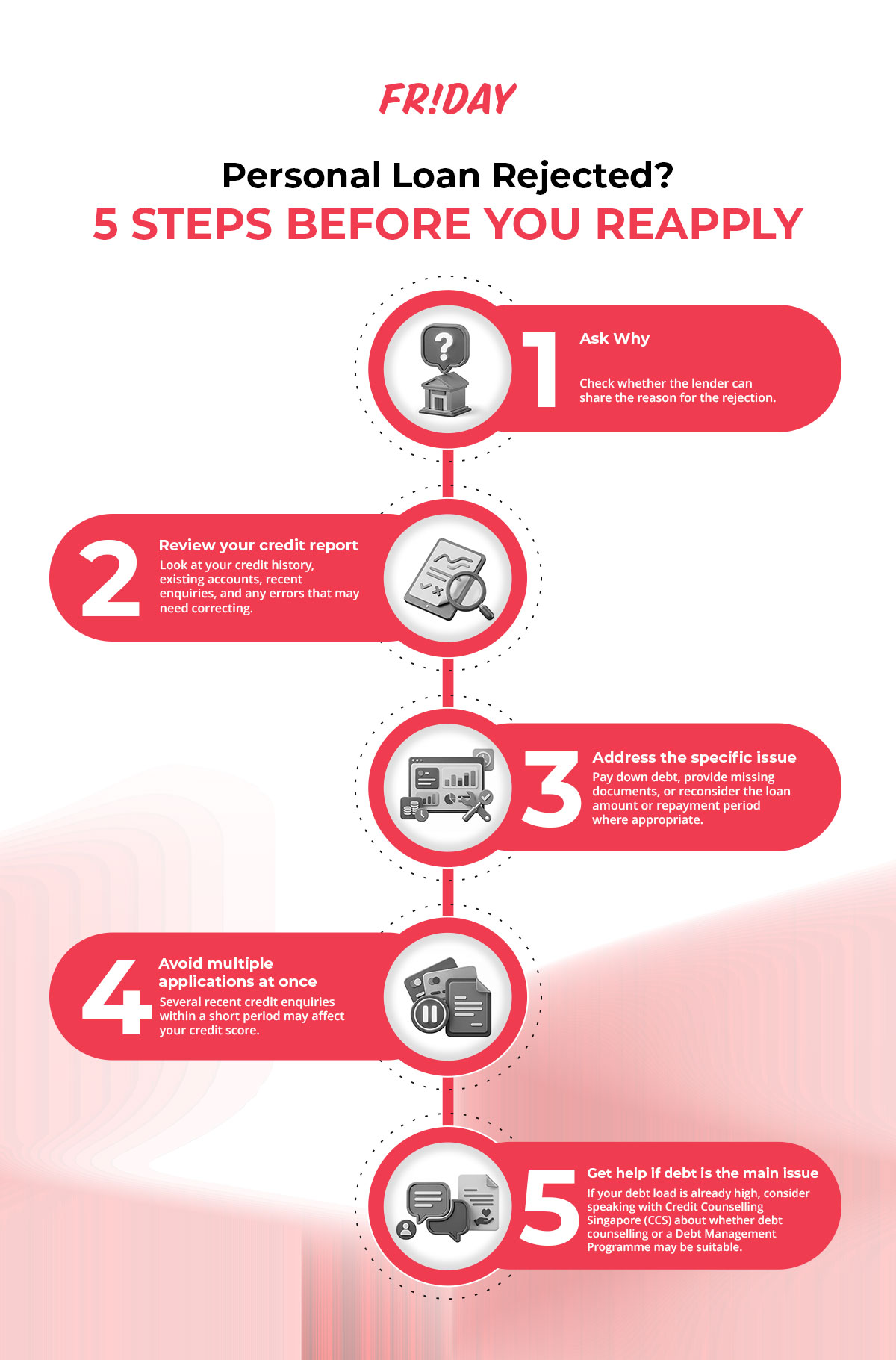
There is no single solution after a loan rejection. The most appropriate next step depends on the reason for the rejection and your financial circumstances. Each option involves its own trade-offs.
Reapplying after addressing the specific issue.
This directly targets whatever caused the rejection and may put you in a stronger position when you reapply. The trade-off is time: some issues, such as paying down existing debt, may take time to address.
Waiting and strengthening your profile more broadly.
Building a stronger track record of stable income, responsible borrowing, and on-time repayments may improve your prospects with a range of lenders over time. However, this is a longer-term approach and may not help immediately if you need funds soon.
Considering a licensed money lender.
A licensed moneylender in Singapore operates under a separate regulatory framework from banks. Borrowing records are assessed through the Moneylenders Credit Bureau (MLCB), which is distinct from CBS, and income-based borrowing limits apply across all licensed moneylenders combined.
This may be a legitimate, regulated option to explore, particularly if a bank’s specific criteria, such as a minimum income threshold or documentation requirements for variable income, do not fit your situation. However, it is important to understand what this does and does not solve. A licensed moneylender will still assess affordability and is not a workaround for a genuine debt or income problem.
For example, if a bank declined your application because your existing financial obligations are already high relative to your income, a licensed moneylender will still assess your income, existing obligations and repayment capacity before deciding what it can responsibly offer.
You can also learn more about how the application and verification process works with a licensed moneylender, and how to verify that a lender is licensed before proceeding.
Credit counselling and debt restructuring.
If the underlying issue is a high debt burden rather than a documentation gap or temporary setback, credit counselling may be worth considering. Credit Counselling Singapore’s Debt Management Programme helps eligible individuals establish structured repayment arrangements with participating banks. The organisation also offers the Moneylender Debt Management Programme (MDMP) for eligible borrowers with participating licensed moneylenders.
Where the priority is managing and reducing existing debt, these programmes may be more appropriate than seeking additional borrowing.
As an example of the licensed moneylender option discussed above, IFS Consumer Services Private Limited (Licence No. 85/2026), operating under the Friday Finance brand, is a licensed moneylender in Singapore. It follows a structured application process within Singapore’s regulated moneylending framework, including assessment through the Moneylenders Credit Bureau (MLCB) and an in-person identity verification meeting before any loan is granted. From 15 September 2026, eligible unsecured personal loans granted by licensed moneylenders are subject to a mandatory three-business-day cooling-off period, subject to MinLaw’s rules on fee retention.
Friday Finance is one option among several that borrowers may consider. However, it is not a substitute for addressing the underlying reason behind an earlier rejection. If the original issue relates to income, debt levels, affordability, or documentation, those factors remain important regardless of the lender being considered.
To better understand your options, you can explore the types of personal loans available and use a loan calculator to estimate how different loan amounts and repayment periods may affect your monthly repayments before deciding whether to apply.
A rejected personal loan application does not necessarily mean you will never qualify for a loan. In many cases, it simply indicates that one or more aspects of your application, such as income, existing debt obligations, credit profile, or supporting documents, may not have met a lender’s requirements at that point in time. Rather than applying to multiple lenders at once, it is often more useful to understand the reason for the rejection, where possible, and address the underlying issue before reapplying. Doing so can help you make more informed borrowing decisions and improve your chances of approval in the future.

Friday Finance is a product of IFS Consumer Services Private Limited, a licensed moneylender regulated by the Registry of Moneylenders of the Ministry of Law in Singapore

