QUICK ANSWER:
The Registry of Moneylenders in Singapore, maintained by the Ministry of Law, is the official source for checking whether a moneylender is licensed. It lists key details such as the lender’s registered business name, licence number, business address and website. Before applying for a loan or sharing personal information, compare these details against the latest registry to confirm that the lender is legitimate. The registry confirms licensing status, but it does not assess loan suitability, pricing or service quality.
✦ KEY TAKEAWAYS
If someone offers you a loan, you have very little to go on. A company name. Maybe a website. Perhaps a number that looks like a license.
Singapore's approach gives borrowers an official starting point for verification. Rather than asking borrowers to judge whether a company appears legitimate, the Registry of Moneylenders under the Ministry of Law (MinLaw) publishes the official list of licensed moneylenders operating in Singapore.
The check belongs at the start of the process, before you share personal information such as your NRIC number, address, or contact details. Verifying the lender first reduces the risk of giving sensitive information to an unlicensed or fraudulent operator.
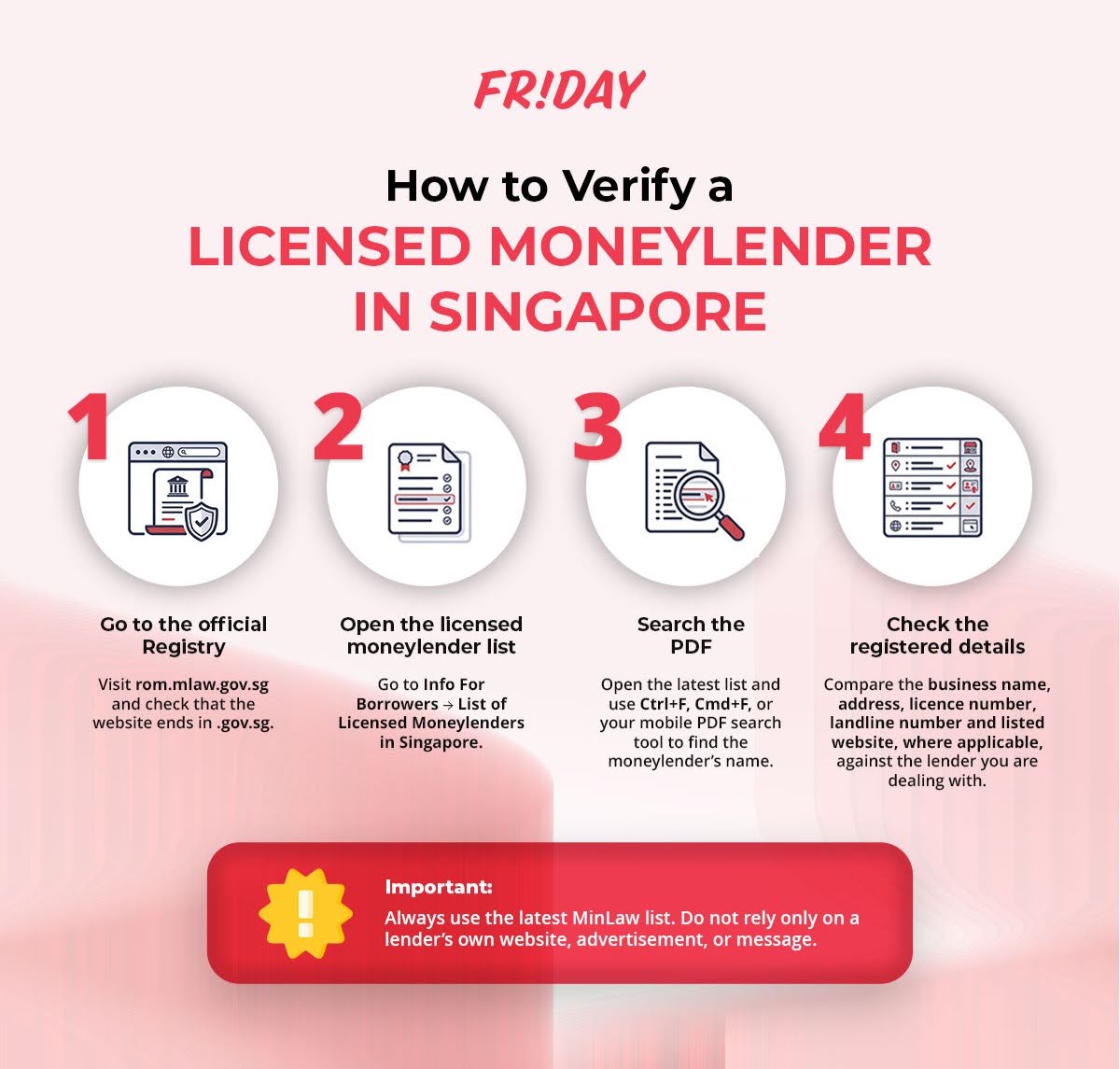
The official list lives on the Registry of Moneylenders website. Here is what you can do:
1. Go to rom.mlaw.gov.sg — the Registry of Moneylenders site. Confirm the address ends in .gov.sg, which is how Singapore government websites are identified.
2. Open the Info For Borrowers menu.
3. Select List of Licensed Moneylenders in Singapore.
4. On that page, click the link to view the complete list. It opens as a PDF document.
5. Use your browser or PDF reader's search function — Ctrl+F on Windows, Cmd+F on Mac, or the search icon in most mobile PDF viewers — to look up the moneylender's name.
One practical point to know before you start: the current list is provided as a document rather than a dedicated lender-name search tool. Open the PDF and use its search function to find the moneylender you want to verify. Knowing this beforehand makes the check straightforward and avoids relying solely on information provided by the lender itself.
Each entry on the list carries six fields, four of which are especially useful for verification. Knowing what each one is for makes the check far more useful than simply confirming a name appears.
Note: MinLaw labels the license column "Licence No." on the official document. We use "license" elsewhere in this article for consistency with our other guides.
The Business URL column is easy to overlook, but it is particularly useful for verification. MinLaw specifically advises checking a moneylender's physical address and website address against the official list. This matters because scammers may create bogus websites or use website addresses that closely resemble those of licensed moneylenders.
A second detail worth knowing: some moneylenders operate from more than one approved location, and their entry may list each one separately, marked I, II, III and so on. Seeing multiple addresses under one entry does not by itself indicate a problem.
License numbers on the current list appear in a number-and-year format — for example, 85/2026.
A moneylender's license in Singapore is valid for 12 months, and licensees must apply to renew it before it expires. Because licenses run in annual cycles rather than indefinitely, the details recorded against a lender can change over time. This can create confusion when borrowers come across license details from an older source:
If the business name appears on the list but the license number you were given does not match the current entry, that is worth raising directly before proceeding — and worth confirming against the list rather than accepting an explanation at face value.
A related mismatch to expect is the consumer-facing brand name. Some licensed moneylenders operate under a brand that differs from the registered entity name on the list. Finding a different legal name in the entry is not automatically a problem, but the website address in that entry should still match the site you were sent to.
The list is republished periodically, and the document carries an “as at” date in its title, for example, “as at 1 August 2026.”
The Registry page does not state a fixed update schedule, so rather than assuming a cadence, the more reliable habit is simply to check the date on the version you are looking at. If you are reading a saved copy, or a list republished on a third-party website, it may be several months old.
The list also handles suspensions. Any moneylender whose license has been suspended is set out separately at the foot of the document, so it is worth scrolling to the end rather than stopping once you have found a name.
If you have searched the current list carefully and the lender does not appear, they are not listed as a licensed moneylender in Singapore. A person generally cannot carry on the business of moneylending without a license unless an exemption or other statutory exception applies. Before concluding that something is wrong, rule out the ordinary explanations:
One further piece of context helps here. The Registry has temporarily suspended the grant of any new moneylending licenses, which means new licenses are not currently being issued. A lender describing itself as newly licensed would therefore be worth checking carefully against the current Registry.
If none of those explains it, MinLaw's guidance is to report possible unlicensed moneylending activity to the Police hotline at 1800-255-0000, or online through the Singapore Police Force's i-Witness portal at police.gov.sg/iwitness. The National Crime Prevention Council also operates the X-Ah Long hotline at 1800-924-5664. Airtime charges may apply to calls made from mobile phones to these numbers.
One related point is worth knowing because it does not require the list at all: MinLaw has stated that licensed moneylenders are not permitted to solicit loans through text messages, phone calls, or social media.
The registry is a strong tool for one question and silent on every other. Knowing where it stops is part of using it well.
That last distinction matters most. Verifying a lender is a necessary step, not a sufficient one. The Registry can confirm that a moneylender is licensed, but you should still check that the website, address and contact details you are dealing with match the official details. And even when the lender is genuine, a loan you cannot comfortably repay can still create financial strain. Verification helps address the legitimacy question; affordability is a separate decision.
Friday Finance provides a practical example of why it is important to check both the business name and website address in the Registry.
Search the current list for IFS Consumer Services Private Limited ("IFSCS"). IFSCS is a licensed moneylender operating under the Friday Finance brand name. Its Registry entry lists the approved business address at 10 Eunos Road 8, #09-04, Singapore Post Centre, Singapore 408600, License No. 85/2026, and www.fridayfinance.sg as its Business URL.
IFSCS is also a wholly-owned subsidiary of SGX-listed IFS Capital Limited. This corporate relationship is separate from the licensing check itself, but it illustrates why a consumer-facing brand name may differ from the legal entity shown in the Registry.
The same verification process should be applied to any moneylender under consideration. Rather than relying on the name or license details presented on a website or in marketing materials, compare them with the information published in the current Registry.
Verifying a moneylender is a straightforward check that gives you an official reference point. Open the current list on the Registry of Moneylenders website, search the business name, and compare the license number, address, and website against what you were told.
If everything matches, you have completed an important part of verifying the lender. The remaining questions — how much to borrow, at what cost, and over what period — are separate, and they deserve the same deliberate attention. If anything does not match, stop and verify the discrepancy before proceeding.
Friday Finance is the consumer-lending brand of IFS Consumer Services Pte Ltd, a licensed moneylender in Singapore regulated by the Ministry of Law (License No. 85/2026). This article is provided for general information only and does not constitute financial advice. Loan approval, amounts, and terms are subject to assessment and can vary depending on your circumstances.

