✦ KEY TAKEAWAYS
Whether you are comparing loan offers or reviewing a loan agreement you have just received, understanding the repayment terms is one of the most important steps before you commit. For many borrowers, this is where the process starts to feel less straightforward. Before signing, it is worth slowing down to understand what each term means and how much you may need to repay.
Loan repayment terms can affect the overall cost of borrowing. Even a small difference in loan tenure or fees can significantly change how much you repay over the life of the loan. Two loans of the same amount may have different total costs depending on the tenure, applicable fees and how interest is calculated.
This guide breaks down the key terms you will find in a loan agreement, explains how interest and fees are calculated under Singapore’s rules, and sets out what to check before you sign. For a closer look at borrowing limits and overall cost, see How Much Can You Borrow From a Licensed Money Lender in Singapore?. If you are still choosing between lenders, Personal Loan Comparison Singapore: How to Choose the Right Lender in 2026 covers that decision in detail.
Loan agreements can be dense, and borrowers may focus on the figures that appear most immediately relevant.
One common example is the monthly instalment. Many borrowers naturally focus on whether they can afford the monthly instalment rather than the total amount they will repay. A lower monthly amount may seem more manageable, but it can also come with a longer tenure and a higher total interest cost. Similarly, the stated monthly interest rate does not show the full cost of borrowing, as fees and the repayment structure may also affect the amount repayable.
Late-payment terms are also easy to overlook, particularly when borrowers expect to repay on time. However, understanding the possible fees and late interest in advance can help provide a clearer picture of the loan’s overall obligations.
Loan agreements often repeat the same core terms. Understanding what each one means can make the repayment structure easier to follow.
See how different loan amounts and tenures may affect your repayments with the Friday Finance loan calculator →
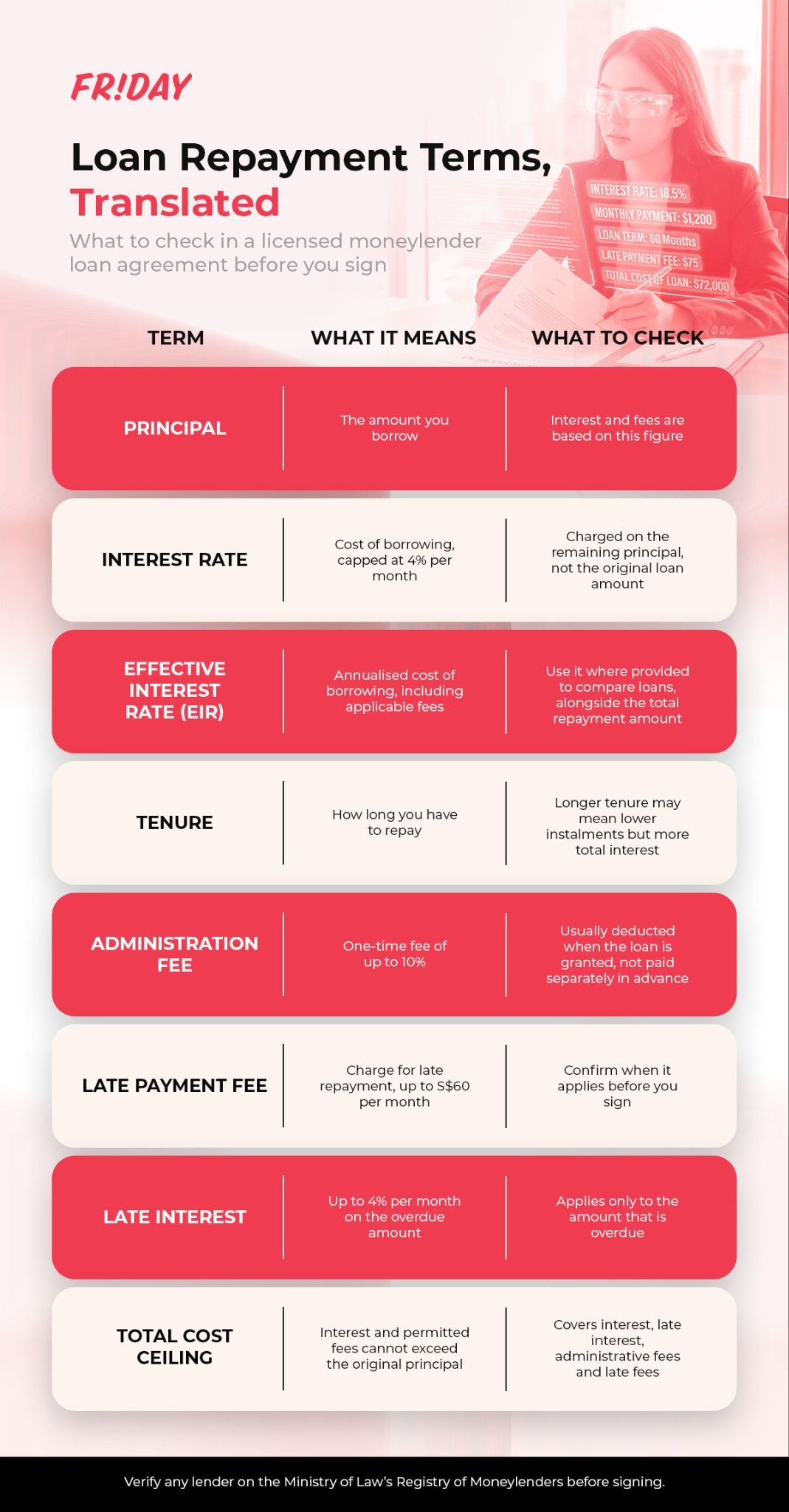
For licensed moneylender loans, interest is calculated on the remaining principal rather than the original loan amount. As repayments reduce the balance, the amount used to calculate interest also decreases.
For example, at the legal maximum of 4% per month, an outstanding principal of S$5,000 would result in S$200 in interest for that month. If the balance later falls to S$4,000, the following month’s interest would be calculated on S$4,000.
This is one reason a shorter tenure may result in lower total interest, provided the rate and other terms remain comparable. The figures above are for illustration only. Your actual interest rate, fees and EIR will depend on your profile and the terms stated in your loan agreement.
Before signing a loan agreement with a licensed moneylender in Singapore, take time to review the following:
Borrowers may worry about “hidden fees” in a moneylender loan agreement. Under Singapore’s licensed framework, permitted charges are regulated and should be disclosed in writing. Even so, it is important to review the agreement carefully so you understand which fees may apply.
The main charges to check are the administration fee, which is capped at 10% of the principal; the late-payment fee, which is capped at S$60 for each month of late repayment; and late interest, which is capped at 4% per month on the overdue amount. Court-ordered legal costs may also apply if legal action is taken.
A licensed moneylender should not ask you to transfer a separate fee in advance to “release” the loan. If you receive such a request, pause the process and verify the lender’s details against the Ministry of Law’s Registry of Moneylenders.
Comparing the cost of different lenders before you commit? Personal Loan Comparison Singapore: How to Choose the Right Lender in 2026 →
If you miss a repayment, a licensed moneylender may charge a late-payment fee of up to S$60 for each month the payment remains late. Late interest of up to 4% per month may also apply, but only to the overdue amount rather than the full outstanding balance.
Repayment activity may also be reflected in your Moneylenders Credit Bureau (MLCB) record. The MLCB maintains information relating to loans from licensed moneylenders, which other licensed moneylenders may review when assessing future applications.
If you expect difficulty making a payment, consider contacting the lender before the due date. This may provide more time to discuss the available options, although any changes to the repayment arrangement will depend on the lender and the terms of the agreement.
The legal limits on interest and fees are fixed and cannot be exceeded. However, some parts of the loan structure, such as the amount, tenure and instalment size, may be discussed before the agreement is finalised, subject to the lender’s assessment and policies.
If the proposed repayment schedule feels difficult to manage, you may ask whether another tenure is available. A longer tenure may reduce each instalment, but it can also increase the total interest paid. The aim should be to choose a repayment schedule that remains manageable throughout the loan term, rather than focusing only on the lowest monthly instalment.
Friday Finance is a licensed moneylender listed on Singapore’s Ministry of Law Registry of Moneylenders, operating as the consumer-lending brand of IFS Consumer Services Pte Ltd (licence No. 85/2026), a wholly-owned subsidiary of SGX-listed IFS Capital Limited.
If a licensed moneylender suits your situation, you can review the terms and eligibility for yourself before deciding anything. View the Friday Finance personal loan →
Understanding loan repayment terms means looking beyond the stated monthly rate. The overall cost may also be affected by the loan tenure, EIR, administration fee and any late-payment charges, all of which should be stated in the loan agreement.
Before proceeding, review the full repayment schedule, confirm the EIR, check that all fees are clearly disclosed and consider whether the instalments fit within your monthly budget. Taking time to understand the terms can help you make a more informed borrowing decision and reduce the risk of unexpected costs.
You can begin with a free loan assessment and review the available terms before deciding whether to proceed. Get a free loan assessment →
Friday Finance is the consumer-lending brand of IFS Consumer Services Pte Ltd, a licensed moneylender (licence No. 85/2026) regulated by the Registry of Moneylenders, Ministry of Law, Singapore. Loans are subject to credit assessment. The maximum loan quantum is set by the Ministry of Law and depends on the borrower’s income and residency status. Interest rates and fees are subject to individual assessment. The Effective Interest Rate (EIR) may differ from the headline interest rate. Borrow responsibly.
The regulatory information in this article is drawn from the following official sources. All figures are subject to change; readers should verify current information directly with the relevant authority.

Friday Finance is a product of IFS Consumer Services Private Limited, a licensed moneylender regulated by the Registry of Moneylenders of the Ministry of Law in Singapore

