✦ KEY TAKEAWAYS
It is common to receive a loan offer out of the blue — a text message, a WhatsApp note, or a social media post promising quick approval and an easy process. For anyone weighing a short-term borrowing decision, it is not always obvious which of these offers come from a properly licensed moneylender in Singapore and which come from an unlicensed moneylender operating outside the rules.
Licensed and unlicensed lenders operate differently, which affects how much a loan can cost and what protections are available to you if something goes wrong. Knowing how to tell the two apart before you respond to an offer or share any details is one of the more useful steps a borrower can take.
This guide explains how licensed and unlicensed moneylenders differ, the signals worth checking before you proceed, and how to verify any lender for yourself. For a broader look at how much you can borrow and what a loan actually costs, see How Much Can You Borrow From a Licensed Moneylender in Singapore?. For a structural comparison of lender types, see Banks vs Licensed Moneylenders: Which is Better?.
Most borrowers begin with a genuine financial need — a bill, a deposit, a short-term gap — and they are weighing the options in front of them. The difficulty is that an unlicensed lender does not always look different from a licensed one at first glance. An offer can arrive through a familiar channel, use professional-sounding language, and promise a fast, straightforward process.
Because of this, telling a licensed moneylender apart from an unlicensed one is less about instinct and more about verification. There are clear, factual checks you can run to give you a reliable way to spot when a moneylender is unlicensed.
A licensed moneylender holds a license issued by the Registry of Moneylenders under the Ministry of Law, in line with the Moneylenders Act and Moneylenders Rules. Each licensee has a license number and appears on the official Registry of Moneylenders, which the Ministry maintains and updates regularly.
Licensed moneylenders are not banks, and they operate under their own set of rules. Those rules include limits on what a loan can cost: interest is capped at 4% per month on the outstanding principal, the administration fee at 10% of the principal, and late fees at S$60 per month. There is also a total charge cap, which is 100% of the original loan amount.
Curious how much a licensed moneylender could offer you?
How Much Can You Borrow From a Licensed Moneylender in Singapore? →
An unlicensed moneylender lends money without holding a license under the Moneylenders Act. These operators — commonly known as loan sharks — are not listed on the Registry of Moneylenders and do not operate within Singapore's regulatory framework. Unlicensed moneylending is also a criminal offence in Singapore.
The table below sets out the main points of difference. Any one of these can help you place a lender on the right side of the line, but verifying the license on the Registry is the most reliable single check.
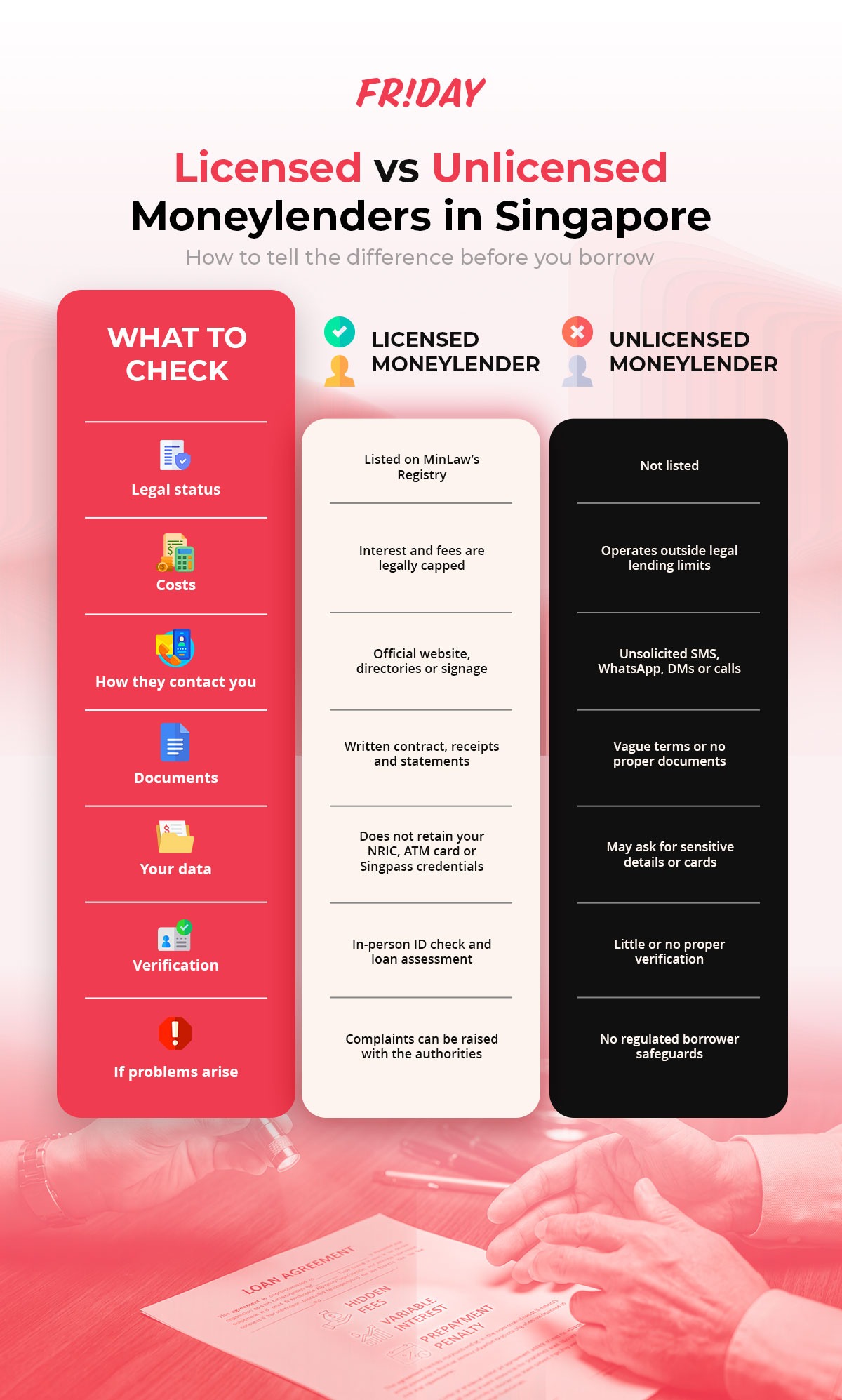
Verify any lender on the Registry of Moneylenders at rom.mlaw.gov.sg before sharing personal details or proceeding with an application.
A few signals tend to indicate that a loan offer falls outside Singapore's licensed framework. None of these is a guarantee on its own, but together they give you a practical sense of what to look for.
Search the lender's name on the Registry of Moneylenders at rom.mlaw.gov.sg. The Registry lists every licensed moneylender in Singapore, along with its registered name and license details, and the Ministry of Law updates it regularly.
If the lender appears on the list, you can confirm that the name and license number match the materials they have given you. If the lender does not appear at all, treat that as a clear reason to pause any further transaction.
Run any offer through the Registry check before you respond, share documents, or sign anything.
Check the Registry of Moneylenders →
For more questions worth asking before you commit, see A Comprehensive Guide to Choosing a Licensed Moneylender in Singapore.
Unlicensed moneylending is a criminal offence in Singapore. Borrowing from an unlicensed operator also means the loan does not come with the safeguards that apply to licensed moneylenders.
For example, the loan may not follow regulated limits on interest and permitted fees, and the lender may not provide proper written terms or documentation. The Registry of Moneylenders regulates licensed moneylenders, but people affected by unlicensed moneylending can still seek assistance through the police and other official reporting channels.
If you have borrowed from an unlicensed moneylender, avoid making further payments or arrangements without first seeking guidance from the police or an appropriate authority.
If you suspect unlicensed moneylending, or you have borrowed from an unlicensed lender and want to report it, there are official channels:
Weighing your options across different lenders?
Personal Loan Comparison Singapore: How to Choose the Right Lender in 2026 →
Friday Finance is a licensed moneylender listed on Singapore's Ministry of Law Registry of Moneylenders, operating as the consumer-lending brand of IFS Consumer Services Pte Ltd (license No. 85/2026), a wholly-owned subsidiary of SGX-listed IFS Capital Limited.
Explore the available loan terms and eligibility requirements to decide whether a licensed moneylender is suitable for your needs.
View the Friday Finance personal loan →
Telling a licensed moneylender apart from an unlicensed one comes down to a small number of factual checks. Licensing is the dividing line: licensed lenders appear on the Ministry of Law's Registry and operate under capped costs, written contracts, and defined protections, while unlicensed lenders operate outside the regulatory framework.
Before responding to a loan offer, verify the lender on the Registry of Moneylenders at rom.mlaw.gov.sg and check how the offer reached you. Do not disclose your Singpass credentials or allow anyone to retain your identity documents, and read the full loan agreement before signing. If anything appears unclear or suspicious, you can seek guidance or report it through the appropriate official channels. These checks can help you identify unlicensed operators and make a more informed borrowing decision.
If you are considering a loan, review the eligibility requirements, total repayment cost and repayment schedule before deciding. You can also verify Friday Finance’s current details on the Registry of Moneylenders.
What is the difference between a licensed and unlicensed moneylender in Singapore?
A licensed moneylender holds a license under the Moneylenders Act and is listed on the Ministry of Law's Registry of Moneylenders. It must follow rules on interest, fees, advertising, and documentation, and its loans come with defined borrower protections. An unlicensed lender operates without a licence, is not on the Registry and does not provide the safeguards associated with Singapore’s regulated moneylending framework.
How do I know if a moneylender in Singapore is illegal?
Check the Ministry of Law’s Registry of Moneylenders at rom.mlaw.gov.sg. It lists all licensed moneylenders, together with their registered details. If a lender is not listed, it is not licensed.
You should also consider how the offer reached you. Licensed moneylenders may advertise only through permitted channels, so unsolicited loan offers sent by SMS, WhatsApp, social media or phone call are a warning sign. A licensed lender should also never ask you to disclose your Singpass password or other login credentials, or retain your NRIC or ATM card.
What are the red flags of an unlicensed moneylender in Singapore?
Common signals include an unsolicited loan offer through messaging or social media, a request for your Singpass login credentials or to hold your NRIC or ATM card, loan terms that are not put in writing, a demand to pay a fee before the loan is disbursed, and approval with no assessment. Any of these is a reason to verify the lender on the Registry before going further.
What happens if I borrow from an unlicensed moneylender in Singapore?
Borrowing from an unlicensed moneylender means the loan does not come with the safeguards that apply to regulated lending, such as prescribed limits on interest and fees, required loan documentation and conduct standards. Unlicensed moneylending is also a criminal offence in Singapore.
However, this does not mean borrowers have no avenues for help. If you have dealt with an unlicensed moneylender, you can seek assistance or report the activity through the Police or the X-Ah Long hotline. Call 999 if there is an immediate threat or danger.
How do I report an illegal moneylender in Singapore?
Call 999 if there is an immediate threat or emergency. For non-urgent reports of suspected unlicensed moneylending, contact the Police Hotline at 1800-255-0000 or the X-Ah Long Hotline at 1800-924-5664.
To report a potentially non-compliant advertisement or raise concerns about the conduct of a licensed moneylender, contact the Registry of Moneylenders at 1800-2255-529 or submit an enquiry through the Contact Us @ OneMinLaw form on mlaw.gov.sg.
Friday Finance is the consumer-lending brand of IFS Consumer Services Pte Ltd, a licensed moneylender (license No. 85/2026) regulated by the Registry of Moneylenders, Ministry of Law, Singapore. Loans are subject to credit assessment. The maximum loan quantum is set by the Ministry of Law and depends on the borrower's income and residency status. Interest rates and fees are subject to individual assessment. The Effective Interest Rate (EIR) may differ from the headline interest rate. Borrow responsibly.
The regulatory information in this article is drawn from the following official sources. All figures are subject to change; readers should verify current information directly with the relevant authority.

