✦ KEY TAKEAWAYS
At some point, many people in Singapore find themselves needing funds that a bank loan may not easily cover — an unexpected medical bill, a gap between paydays, or a need that doesn't fit a bank's criteria or timelines. For situations like these, a licensed moneylender can be a practical option.
The licensed moneylending industry in Singapore is closely regulated, with clear rules on what lenders can charge, how much you can borrow, and how you should be treated. Knowing how the system works helps you borrow safely, avoid unlicensed operators, and choose terms that are manageable for you.
This guide is an overview of borrowing from a licensed moneylender in 2026–from verifying a lender and understanding your limits, to the application process and what happens after you repay.
A licensed moneylender is a business authorised to lend money under Singapore's Moneylenders Act and regulated by the Registry of Moneylenders, which operates under the Ministry of Law. Every licensed lender must hold a valid licence and follow rules on interest, fees, advertising and how borrowers are treated.
It helps to see where licensed moneylenders sit relative to other options. Banks are regulated separately by the Monetary Authority of Singapore (MAS) and typically offer larger loans at lower interest over longer terms, albeit with stricter eligibility. Licensed moneylenders generally provide smaller, shorter-term loans and may assess applicants under different eligibility criteria, within the caps set by MinLaw. At the other end are unlicensed operators — commonly known as loan sharks — who operate outside the law and offer no borrower protections.
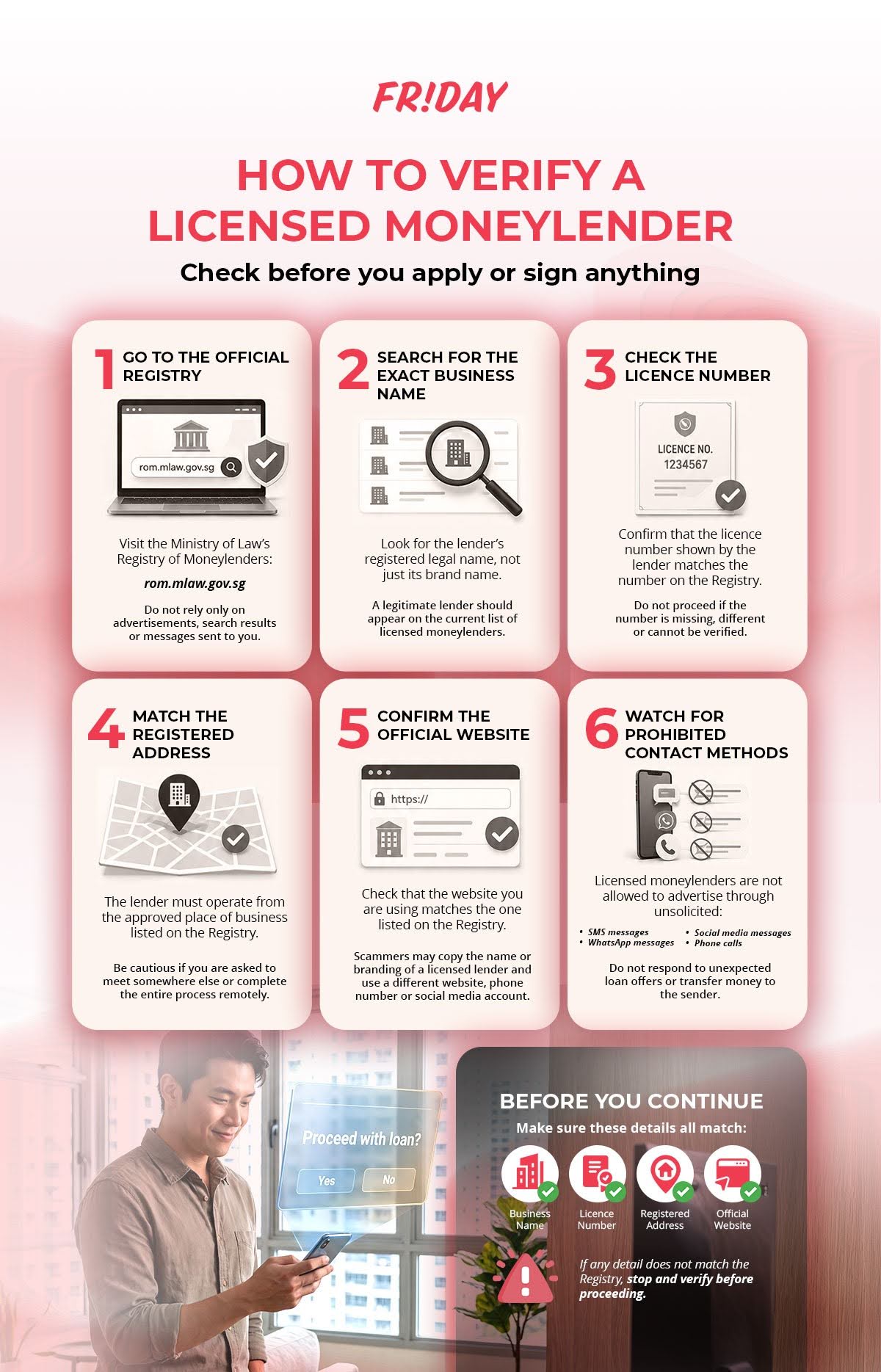
The clearest sign of a licensed moneylender is that it appears on MinLaw's Registry and follows the conduct rules set out in the Moneylenders Act.
Here are a few signs to look out for:
It is also worth knowing that loans made by unlicensed moneylenders are generally unenforceable under Singapore’s moneylending laws. Borrowers dealing with them also do not receive the same regulatory protections that apply to licensed moneylending.

You can confirm whether a lender is licensed in a few minutes by checking its name against the official Registry of Moneylenders on MinLaw's website (rom.mlaw.gov.sg).
The registry is public and lists every currently licensed moneylender in Singapore. Confirm the exact business name, the licence number, and the registered address, since unlicensed operators sometimes use names that closely resemble those of legitimate lenders. Because the official list is updated, you should check it again whenever you are considering a lender rather than relying on an earlier search or advertisement.
Keep in mind that this is your own verification of the lender–you confirming that the business you're considering is legitimate. It's a separate step from your own verification later in the process, when the lender confirms your identity and income.
Secured loans — those backed by an asset such as property — are not subject to these unsecured caps.
Two points are easy to miss. First, the limit is a combined ceiling: if your cap is S$15,000 and you already owe S$13,000 across other licensed lenders, you can borrow only S$2,000 more. Second, the cap is a maximum, not an entitlement. The amount actually approved may be lower, depending on your income, repayment capacity, and borrowing record.
Want to see how loan amount and tenure affect your monthly repayments? Try the Friday Finance loan calculator →
Before approving a loan, a licensed moneylender verifies your identity and assesses your income, existing obligations and repayment capacity.
While the exact steps vary by lender, the process generally follows a familiar shape:
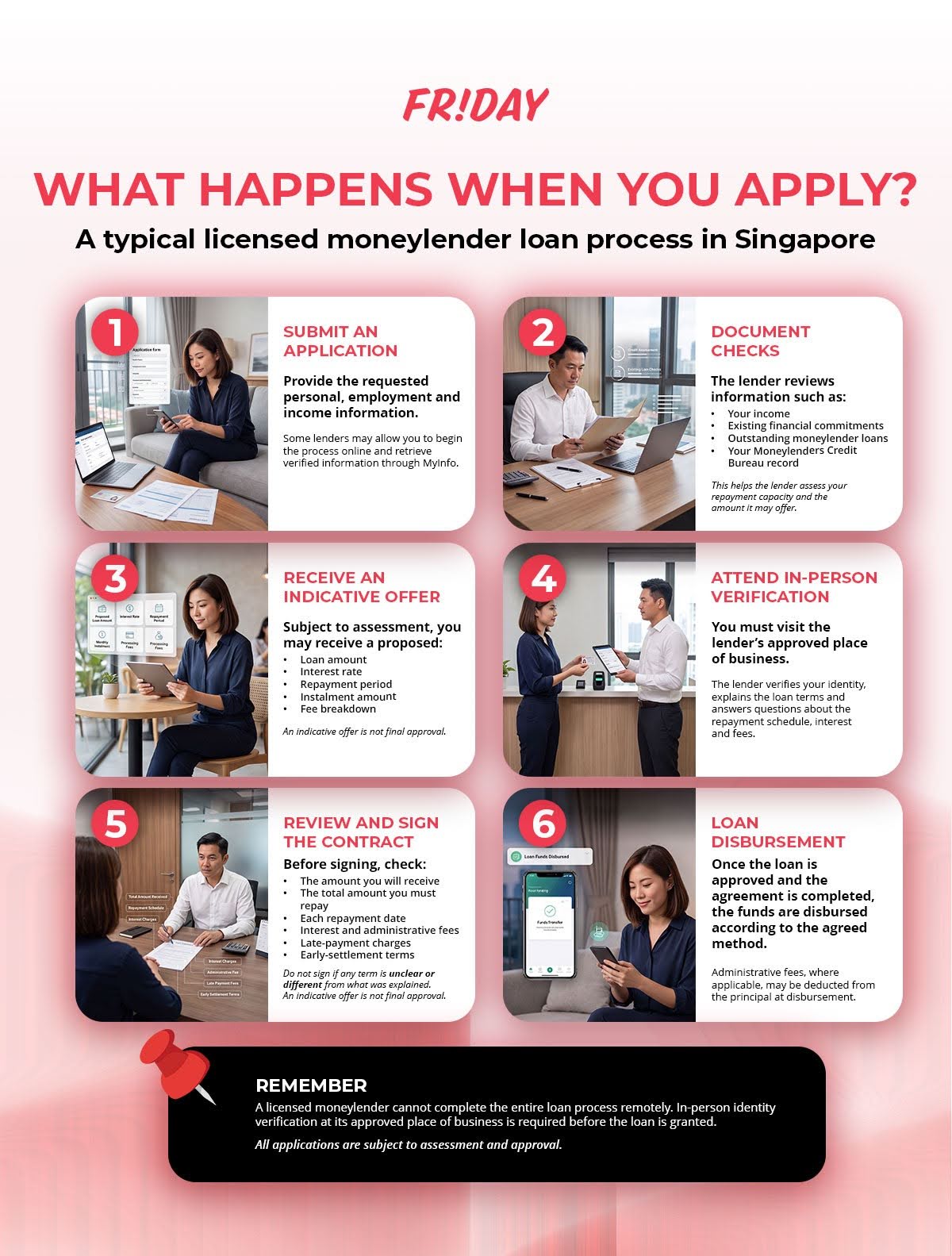
Timing depends on the lender and on how complete your documentation is. Many licensed moneylenders can provide an indicative decision quickly, but a loan is only finalised after you complete the lender's verification steps.
It's reasonable to expect an indicative offer fairly soon after applying, provided you've submitted accurate identification and income documents. From there, the timeline depends on scheduling and attending the appointment to verify your details and sign, after which disbursement usually follows.
A few things can extend the process: incomplete or inconsistent documents, additional income verification for self-employed applicants, or affordability checks where your existing obligations are close to your borrowing cap. Setting realistic expectations helps you plan around the timing of your loan.
Repaying a licensed moneylender on time is recorded in the Moneylenders Credit Bureau (MLCB), and a consistent record can support future applications with licensed lenders. The MLCB, however, is separate from Credit Bureau Singapore (CBS), on which banks rely.
The MLCB acts as a central repository of moneylending data, introduced to help licensed lenders make more informed and responsible lending decisions. When you repay on schedule, that history is reflected in your MLCB record, which a lender may consider when assessing a future application.
It's important to understand the boundary here. The MLCB and CBS are two separate systems. Banks and other financial institutions assess applications using CBS data, while licensed moneylenders work with the MLCB.
MLCB records are maintained separately from CBS records and are used by licensed moneylenders when assessing applications. In practical terms, a strong repayment record can strengthen your standing within the licensed money lending system, but it is not the same as building a bank credit score.
The more useful way to view repayment is simply as part of managing your own finances well. Repaying on time reduces what you owe, helps you avoid late charges, and keeps your borrowing within comfortable limits. These are benefits that hold regardless of which bureau records what.
Like any financial tool, borrowing from a licensed moneylender has both advantages and trade-offs.
On the one hand, licensed moneylenders can be accessible to borrowers whom banks may decline, including those with limited credit history. Their costs and conduct are capped and regulated, contracts must be in writing with terms clearly explained, and the application process is often more straightforward than a bank's.
On the other hand, the cost of borrowing is a real consideration. Interest of up to 4% per month is higher than a typical bank personal loan, tenures tend to be shorter, and the income-based caps mean these loans suit smaller, shorter-term needs rather than large or long-term financing. Missing payments adds late interest and a late fee, within legal limits.
The steady principle through all of this: a loan is best treated as a tool for a genuine, planned need, and the right amount is the one you can comfortably repay alongside your existing commitments. The borrowing caps exist to prevent over-lending and not as a target to reach.
If repayment becomes difficult, contact the lender early to discuss the available options or seek guidance from a recognised credit counselling service. If you are concerned about taking on further unsecured moneylender loans, the MLCB also provides a self-exclusion facility.
IFS Consumer Services Private Limited ("IFSCS") is a licensed moneylender (Licence No. 85/2026) operating under the Friday Finance brand name and is also a subsidiary of SGX-listed IFS Capital Limited, regulated by the Registry of Moneylenders under the Ministry of Law.
Friday Finance is one example of a licensed moneylender operating within this framework. Its interest rates begin at 0.88% per month. Borrowers who meet the conditions for full and timely repayment will receive a 50% refund of the administrative fee after full settlement. Additionally, all unsecured personal loan borrowers are provided with complimentary Personal Loan Protection Insurance at no additional cost. There is no penalty for early repayment. Interest is calculated daily on the reducing balance, so borrowers pay interest only for the days they hold the loan.
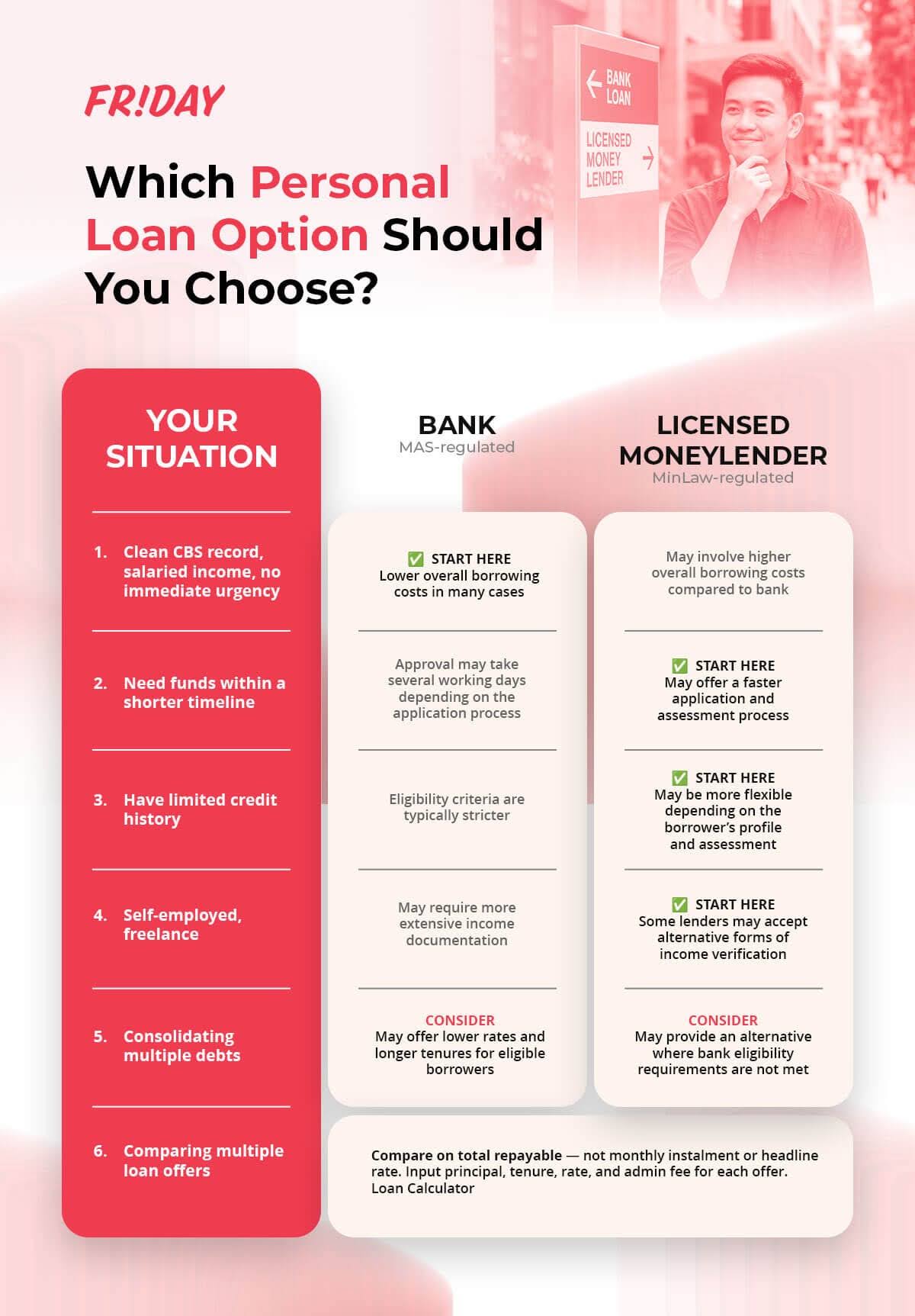
(Infographics from https://www.fridayfinance.sg/blog/personal-loan-comparison-singapore-how-to-choose-the-right-lender-in-2026)
Want to see which type of loan suits your situation? Explore Friday Finance's personal loan types →
Borrowing from a licensed moneylender in Singapore can be a sensible option when approached with a clear understanding of how it works. The essentials are straightforward: verify the lender on MinLaw's Registry, know the legal caps on interest and borrowing, recognise the red flags of unlicensed operators, borrow within your means, and plan your repayment.
Whenever you're considering a specific lender, the most reliable starting point remains the official Registry of Moneylenders.
When you're ready to take the next step, you can find out how to start a personal loan application with Friday Finance →
Looking for more guidance on borrowing and managing money? Read more on the Friday Finance blog →

Friday Finance is a product of IFS Consumer Services Private Limited, a licensed moneylender regulated by the Registry of Moneylenders of the Ministry of Law in Singapore

