✦ KEY TAKEAWAYS
A personal loan can be a practical way to manage a large or unexpected expense in Singapore. It may be used to consolidate existing debts, cover a medical bill, finance a renovation or manage a temporary cash-flow gap. Because it is unsecured, you do not need to pledge an asset as collateral.
Before deciding, it is important to consider where to borrow, how much you need, what the loan will cost and whether it is suitable for your circumstances. The rules for licensed moneylenders are clearly set out, and understanding them can help you compare your options, recognise potential risks and make a more informed decision.
This guide provides an overview of personal loans in Singapore in 2026, including how they work, who may qualify, how much you may borrow, what costs to expect and how the application process works. We have also linked to more detailed guides where you may want to explore a topic further.
A personal loan is an unsecured loan that you repay in fixed monthly instalments. It may be offered by a bank or a licensed moneylender and does not require you to pledge an asset as collateral. Instead, lenders assess factors such as your income, residency status, existing financial commitments and credit history.
Personal loans may be used for purposes such as consolidating debts, covering an emergency, financing a renovation or wedding, or managing a temporary cash-flow gap. The loan is repaid over an agreed term, with each instalment covering part of the principal and the applicable interest.
A secured loan is backed by an asset, such as property, that the lender may claim if you do not repay. Most personal loans are unsecured, which means there is no such backing. Unsecured loans may involve fewer collateral-related steps, but approval, processing time and borrowing limits still depend on the lender and your financial profile. We cover those limits under “How much can you borrow” below.
Where Can You Borrow: Banks or Licensed Moneylenders?
In Singapore, personal loans come from two main regulated sources: banks, which are overseen by the Monetary Authority of Singapore, and licensed moneylenders, which are regulated by the Ministry of Law (MinLaw). Both are legal, and each suits a different kind of borrower.
Banks usually offer larger loans over longer tenures at lower interest, but their eligibility is stricter and often includes a minimum annual income and a healthy credit score. Licensed moneylenders tend to offer smaller, shorter-term loans with more accessible criteria, which is why they are a common choice for borrowers a bank has turned down.
If you want a full walkthrough of borrowing from a licensed moneylender, including how to verify one and the warning signs to watch for, read our licensed moneylender guide. You can also see how to compare lenders and choose the right one, or read the fuller guide on choosing a licensed moneylender in Singapore.
Not sure which lender type fits your situation? Compare your options in how to choose the right lender →
Most lenders look at a few basic factors before assessing the details: you are usually at least 21, you are a Singaporean, Permanent Resident or eligible foreigner living in Singapore, and you have a stable income that you can verify. Meeting these requirements is only the starting point. The amount and rate you are offered will depend on your overall financial profile.
Beyond age and residency, lenders want to see evidence of income and a manageable level of existing debt. Banks tend to set a minimum annual income threshold, while licensed moneylenders may use different income and affordability criteria. For the full checklist, see personal loan eligibility criteria in Singapore.
If you are self-employed or earn gig income, you may still qualify. The main task is proving what you earn. Depending on the lender, accepted documents may include your Notice of Assessment, CPF contribution history or bank statements. Lenders may also look for consistency over time rather than a fixed monthly payslip. Our guide for self-employed and gig borrowers covers what to prepare, and Friday Finance offers a loan built for gig and self-employed borrowers.
Lenders check your credit report to see how you have handled borrowing before. In Singapore, your bank and credit card history sits with Credit Bureau Singapore (CBS), while borrowing from licensed moneylenders is recorded separately with the Moneylenders Credit Bureau (MLCB). Together they show your repayment behaviour and how much you already owe, which is how a lender judges whether you can take on more. You can request your own CBS report for a small fee before applying, so you can check for any errors and better understand your credit position.
A lower credit score may narrow your options or affect the rate you are offered, but it does not automatically rule you out. Licensed moneylenders may assess each application based on the borrower’s overall financial profile. Our guide to getting low-interest personal loans with bad credit explains how to strengthen your position before you apply.
If you borrow from a licensed moneylender, the maximum amount available for an unsecured loan depends on your annual income and residency status. This cap applies across all licensed moneylenders combined, not to each lender separately. The current MinLaw limits are:
To illustrate, if your limit is S$15,000 and you already owe S$13,000 to other licensed lenders, you can only borrow S$2,000 more. The amount actually approved may be lower once the lender considers your income, repayment capacity and borrowing record.
However, banks are not bound by these moneylender caps. They assess factors such as your income, existing commitments and credit record, and may offer larger loan amounts or longer tenures to eligible borrowers.
For worked examples by income band, see how much you can borrow from a licensed moneylender in Singapore.
Want to see how the loan amount and tenure affect your monthly repayments? Try the Friday Finance loan calculator →
The headline interest rate is only one part of what a loan costs. Fees and the way interest is calculated matter just as much, so comparing the full cost gives you a clearer picture than the advertised rate alone.
Licensed moneylenders are capped by law at a maximum interest rate of 4% per month, regardless of your income, loan size or credit profile. Interest is charged on the reducing balance, so as you repay the loan, it is calculated on the remaining principal. Bank loans are often quoted as a flat rate alongside an Effective Interest Rate, or EIR, which makes the EIR a more reliable basis for comparing one offer with another. Our guide to understanding personal loan interest rates breaks this down.
On top of interest, a licensed moneylender may charge a one-time administrative fee of up to 10% of the loan principal. If you miss a payment, there may be a late fee of up to S$60 for each month of late repayment, plus late interest of up to 4% per month on the overdue amount. There is also an important protection: by law, the combined interest, late interest, administrative fee and late-payment fees cannot exceed the original principal borrowed. Court-ordered legal costs may apply separately. Our interest rate guide on spotting a personal loan’s real cost shows where hidden costs tend to hide.
Your tenure changes what the loan actually costs you. A shorter tenure means higher monthly instalments, but you clear the balance sooner and pay less interest overall. A longer tenure eases the monthly pressure, though you will usually pay more in total by the end. Neither is automatically better, so weigh the monthly figure against your household budget rather than defaulting to the longest term on offer.
Before you sign anything, check the repayment schedule, the total amount you will repay, the fee breakdown, and the penalties for paying late or settling early. Our guide to licensed moneylender repayment terms you should know explains what to look for.
A personal loan may be used for different needs. Choosing the right option is mostly about matching the loan to its purpose. Here are the common types in Singapore:
Want to see which type of loan suits your situation? Explore Friday Finance’s personal loan types →
The application process is generally straightforward, although some preparation may be needed before you apply. A typical application follows these steps:
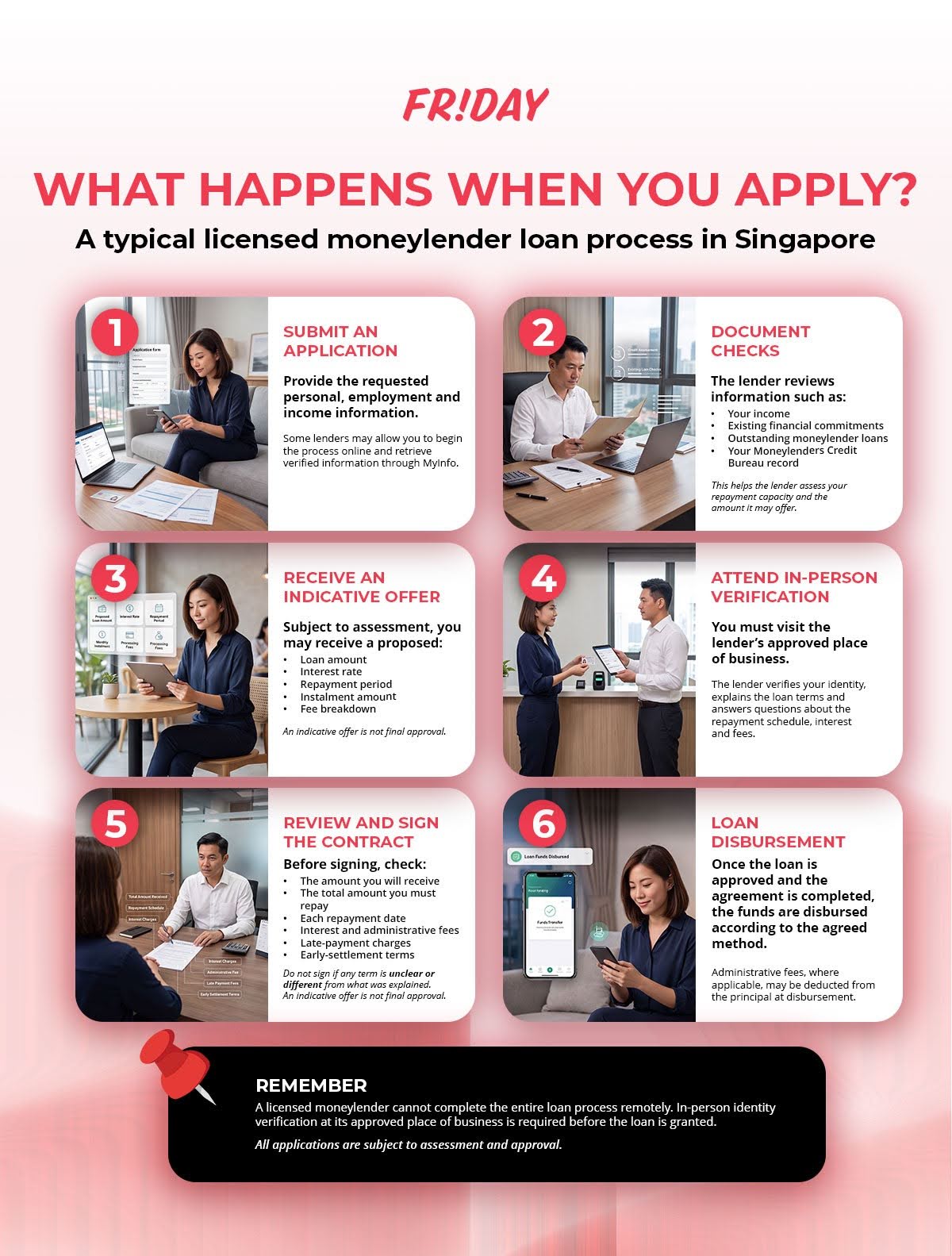
Timelines vary by lender. A bank application may take a few days or longer once you have submitted the form and supporting documents, as the assessment and verification steps can be more involved. A licensed moneylender may process the application more quickly, although the loan must still be finalised in person at the lender’s approved premises. Whichever route you take, having your documents ready can help the process move more smoothly.
You may improve your chances by maintaining a good repayment record, reducing some existing debt before you apply, making sure your income documents are accurate, and applying for an amount that fits comfortably within your budget. Our guides on improving your chances of approval and what to expect when you apply go into more detail.
A personal loan is not always the right option. Sometimes a credit card or a different type of loan may suit you better.
A credit card can work out cheaper for small, short-term spending that you can repay in full, but its revolving interest can become costly if you carry a balance. For larger sums, a personal loan’s fixed instalments are usually easier to plan around. Our guide on personal loan vs credit card in Singapore compares the two. A business loan is different: it is built for company financing and assessed on your business rather than your personal finances. Our guide on business vs personal loan: 4 key differences explains when each one applies.
A personal loan is a useful tool for a genuine, planned need. It becomes a burden when it is used to cover a shortfall that keeps coming back. As a rule of thumb, the right amount to borrow is the amount you can comfortably repay alongside your existing commitments.
Before you borrow, it helps to ask a few honest questions. Is the expense necessary? Does the monthly repayment fit your budget with room to spare? Have you compared the total cost across a few lenders? Our guides on whether you should get a personal loan and the questions to ask before taking a loan are good places to start. Once you have borrowed, staying on top of the loan by paying on time, avoiding new debt, and keeping a small buffer keeps it working in your favour, and our tips to manage your personal loan can help. If repayment ever becomes difficult, contact your lender early to talk through the options, or reach out to a recognised credit counselling service.
Whichever lender you are considering, verify it first. A licensed moneylender should appear on MinLaw’s official Registry of Moneylenders, with a matching business name, licence number and registered address.
Be wary of things that licensed lenders should not do, such as sending unsolicited loan offers by SMS or WhatsApp, asking you to make a separate payment before the loan is disbursed, or offering approval without proper assessment and identity verification.
You can check any lender yourself on the Registry of Moneylenders. For a fuller walkthrough of verifying a lender and spotting the warning signs, see our licensed moneylender guide, along with how to choose the right lender and choosing a licensed moneylender.
IFS Consumer Services Private Limited ("IFSCS") is a licensed moneylender (Licence No. 85/2026) operating under the Friday Finance brand name and is also a subsidiary of SGX-listed IFS Capital Limited, regulated by the Registry of Moneylenders under the Ministry of Law.
Friday Finance is one example of a licensed moneylender working within this framework. Its interest rates begin at 0.88% per month. Borrowers who meet the conditions for full and timely repayment will receive a 50% refund of the administrative fee after full settlement. Additionally, all unsecured personal loan borrowers are provided with complimentary Personal Loan Protection Insurance at no additional cost. There is no penalty for early repayment. Interest is calculated daily on the reducing balance, so borrowers pay interest only for the days they hold the loan.
Ready to explore your options with a licensed lender? See the Friday Finance Personal Loan →
Borrowing through a personal loan can be a sensible way to manage a large or unexpected cost, as long as you go in with a clear understanding of how it works. The essentials are straightforward: know where you are borrowing from, understand the legal caps on interest and borrowing, compare the total cost, borrow within your means, and plan your repayment from the start.
When you are ready, find out how to start a personal loan application with Friday Finance →
A few misconceptions may prevent people from borrowing responsibly or lead them towards the wrong lender. Here are three worth clearing up.
Myth: Personal loans are only for emergencies. In practice, they may also be used for planned expenses such as a renovation, wedding or education, or to consolidate several existing debts into one repayment.
Myth: The interest is always too high. Licensed moneylenders are capped by law at 4% per month on the reducing balance. The combined interest, late interest, administrative fee and late-payment fees also cannot exceed the original principal borrowed, although court-ordered legal costs may apply separately. Rates still vary between lenders, so comparing the total cost of borrowing is what matters.
Myth: Only banks are safe. Licensed moneylenders operate under the Moneylenders Act, with capped rates, capped fees and written loan agreements. The greater risk comes from borrowing from an unlicensed lender, which operates outside Singapore’s regulated moneylending framework.
Looking for more guidance on borrowing and managing money? Read more on the Friday Finance blog →
Friday Finance is the consumer-lending brand of IFS Consumer Services Pte Ltd, a licensed moneylender (Licence No. 85/2026) regulated by the Registry of Moneylenders, Ministry of Law, Singapore. Loans are subject to credit assessment. The maximum loan quantum is set by the Ministry of Law and depends on the borrower’s income and residency status. Interest rates and fees are subject to individual assessment. The Effective Interest Rate (EIR) may differ from the headline interest rate. Borrow responsibly.
The financial and regulatory information in this article is drawn from the following official sources. All figures are subject to change, and readers should verify current information directly with the relevant authority.

Friday Finance is a product of IFS Consumer Services Private Limited, a licensed moneylender regulated by the Registry of Moneylenders of the Ministry of Law in Singapore

